A better way to produce affordable housing

In 1937, affordable housing was invented. It wouldn't be called "affordable housing" until the 1980s, and lots of housing had been affordable before then, but that was the year that the United States Housing Act introduced income-restricted housing. Later amendments would tie these income restrictions to Area Median Income (AMI), producing the "affordable housing" system we know and love (/s) today.
There is another definition of "affordable housing" which is "housing which costs less than 30% of household income, utilities and operating expenses included." We call tenants who pay more than this threshold "rent burdened."
Of course, the vast majority of affordable (<30% of income) housing is not affordable (income-restricted) housing. I hear you protesting: "Oh, you mean 'naturally affordable housing?' Isn't that just bad, nasty slums?" Using ACS and tax roll data I estimate that about 40% of the market-rate housing in Kingston, NY, where I live, rents at below 80% AMI levels (the usual limit for "affordable" income-restricted housing). Maybe that's all slums, I don't know.
Anyway, I am not going to try to convince you that for-profit market rate housing is a magic bullet for producing broad, long-term affordability. That's not the idea. You must only tolerate this brief note: There is overwhelming empirical evidence that places that consistently build more over a long period of time tend to wind up with better quality housing at lower rents than comparable places that build less. There, I said it, that's out of the way. The market cannot solve the housing crisis, but it can help make things less fucked.
The trouble is that calling income-restricted housing "affordable housing" was a marketing ploy and we all took the bait. This language naturalizes a particular ideology of housing. If "affordable" and "income restricted below 80% AMI" are synonymous, then we have a theory of the housing crisis and a plan to fix it. I think this helps explain why the general public is so obsessed with this one wonky policy tool.
Let's talk about a better way to create affordable housing.
Unleash the public sector
Now I know I was singing the praises of private market housing earlier, but look: rents that are managed on a for-profit basis will always rise at least as fast as rents that are managed on a not-for-profit basis. Generally faster. There are exceptions—bad non-profits, systematic mismanagement, etc. But in principle (and most of the time in reality), if rents are being set in order to maximize profits, they are going to be higher.
One way of setting rents in a non-profit-maximizing way is income-restricted (aka "affordable housing") rents. But what about rents that are set according to underlying costs? That's basically what we expect from non-profit and public management. It's sort of the optimal case of rent stabilization.
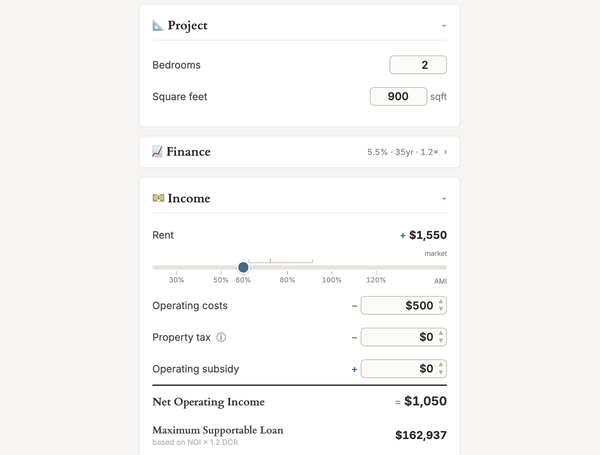
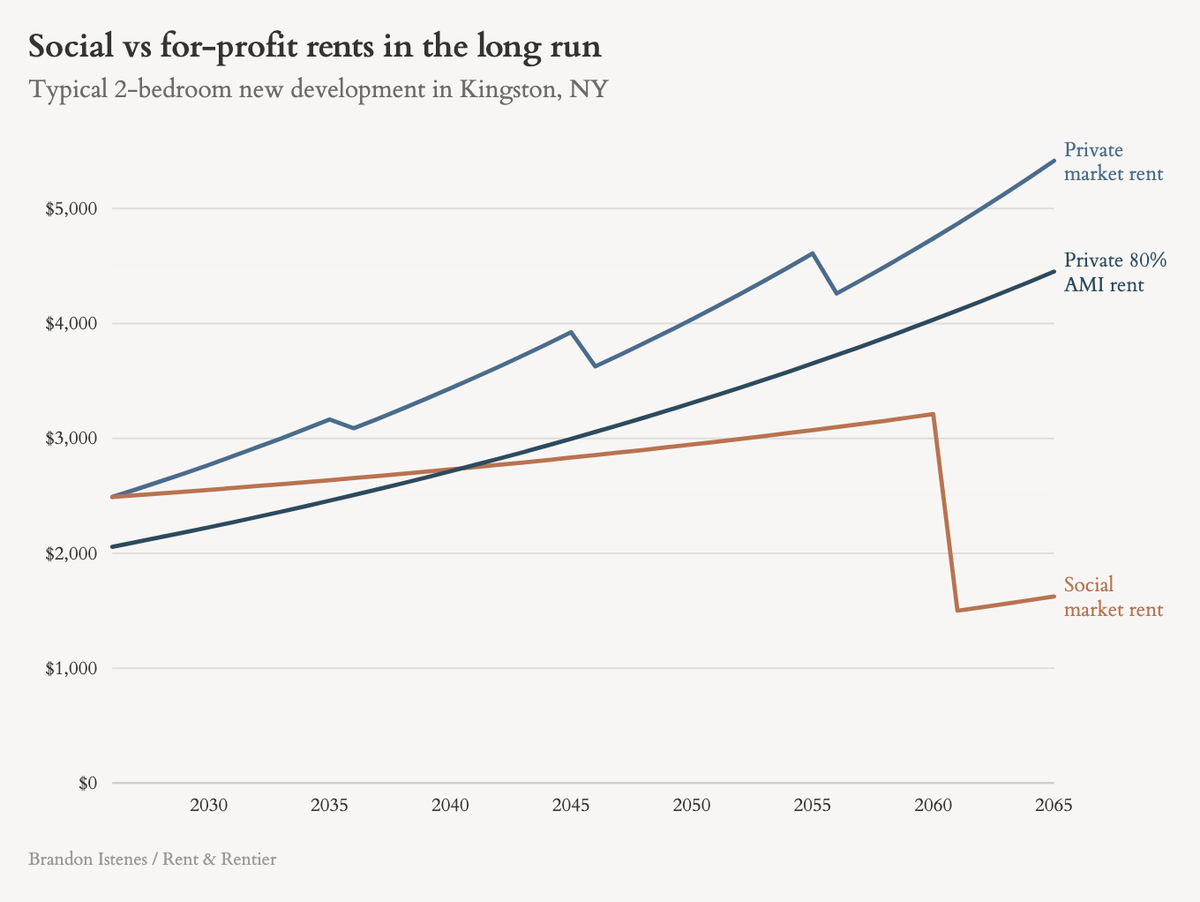
Let's think about Kingston 20 years from now. Let's say we fail to solve the housing crisis, so housing costs increase by an average of 2.7% per year for that time. But let's say that today we want to build some affordable housing for the future of Kingston. We'll use some reasonable assumptions about Kingston development ($300k for a unit, 6.5% interest rate, 20% equity, 1.2 DSCR, $750/mo opex). Consider two options: market-rate public development or private income-restricted development.
Say a for-profit company builds an 80% AMI 2-bedroom apartment this year. It will rent for about $2,056. That company will raise the rent according to AMI changes. In 20 years, it will rent for about 7% below median rent. Not bad! But in order to create that unit, $70,000 in capital subsidy had to be found (very roughly). Maybe this was federal subsidy, or maybe it was a PILOT, or a New York state grant, or capitalized savings from a low-interest public loan. Maybe this was inclusionary zoning, in which case the subsidy just comes from other people's rents being higher. One way or another, you have to come up with $70,000.
Now let's say that you're running a social housing authority (SHA) that creates publicly-owned housing. Or you're running a community land trust (CLT) that has decided to undertake development. Let's say you create a market-rate 2-bedroom apartment in Kingston this year. To cover your costs, you need to rent it for about $2,500. "Who can afford that???" Well, about 20% of Kingston's wage-earning renter households. Those are the people who will pay for this construction to happen. They will move into the apartment, likely moving out of someplace cheaper, and we will use their money to pay for this public good.
Here's the magic: your SHA or CLT is not a profit-maximizing entity. Rents only have to cover costs, plus some reserve, plus whatever subsidy you've decided you need for other (income-restricted) apartments. In 20 years, this apartment can rent for 17% below median rent.
If median 2-bedroom rent in 20 years is $3,550, then the private 80% AMI rents for $3,300, and our public market-rate development rents for $2,950.
Here's what the trajectory looks like, in this simple demonstration model. Private market rent declines reflect the building aging.
What's amazing is we didn't have to find any subsidy for it. The rent paid for the apartment. The apartment might exist for 100 years. It is paid off, and we (a public good institution) control it.
And then after 30-35 years, something magical happens. There are no more debt service payments on the apartment. The housing authority owns it free and clear. At that point, rents only need to cover operating expenses. You can rent this apartment at 50% AMI without requiring subsidy. Incredibly, it never required subsidy (and was a nice new build only 30 years ago). You can rent it as a 30% AMI unit with only a small amount of operating subsidy.
You didn't have to spend tax money. You didn't have to find grants. You didn't have to raise other people's rents. You just had to be willing to take the money of people that can afford new housing, and let them live there until they move out. You are using high-income people's money to fund social goods. It's not "tax the rich for social housing," it's more like "make the upper-middle class pay for social housing—and like it."
It doesn't require any actual taxes. We absolutely should tax the rich, but we shouldn't make social housing downstream of that political project.
Zero-subsidy deeply/permanently affordable units. That's what I'm selling you. What it takes is a little patience.
Note that this is different from cross-subsidization. Cross-subsidization is the hot new approach to social housing—building some at market rate to subsidize other units. The numbers I've provided above are what happens if you don't use the market-rate unit to subsidize other units, but just make it as affordable as possible without subsidy. I want to call this "temporal subsidy" but that's a very annoying name. "Delayed subsidy"? "Time subsidy"? Your suggestions welcome. If you increase the rents above what I've shown, then you get cross-subsidy. In practice you will want a mix of cross-subsidy and time subsidy.
Say you take this approach. Your organization or agency, having been empowered to create market-rate units, is now no longer constrained by the availability of tax dollars or grants. Much like a for-profit developer, your main constraint is now whether each project will pencil. (The other main constraint is availability of financing, which is more favorable for a public developer).
This gives you an empowered agency that can genuinely compete with the private sector. It can produce social benefit at the scale of the crisis. This is how you get Vienna. You cannot have Vienna in five years. But you can have it in twenty, if you give up the shibboleth of new unit subsidies. The crisis took 50 years to form. You are not going to fix it in a decade, one way or another.
Available subsidy should be focused on fewer deeply affordable units—these are what really make a difference for homeless or at-risk people. 80% AMI units just aren't that useful, vis-a-vis market rate. But if you want social providers to become a serious player in housing, don't condition their ability to do so on subsidy. The long term path to affordable housing is not through "affordable" housing, but through an empowered social sector.
NB: Earlier I said that at-cost rent is the optimal case of rent stabilization. The reality is messier—landlords will require returns, and some costs (like maintenance) may get deferred indefinitely. Nevertheless, rent stabilization has an important role to play in this picture. If buildings age in to rent stabilization, it works kind of like market-rate social housing. You allow the building's construction to be paid for by those that can afford it, and then you prevent the growth of economic rents. Value from rising rents that would normally accrue to the landlord instead stays with the tenants. Not quite social housing, but not too shabby either.
NB2: Some people like to call older housing "trickle-down" housing, generally in reference to filtering. Since the vast majority of homeowners live quite happily in 30+ year old structures, this is obviously not a serious objection. It just sounds pithy when you tweet it. Safe and dignified housing is a human right; brand spanking new housing is not.